1#Conversations
2Conversations is an open source XMPP (formally known as Jabber) client for
3Android 4.0+ smart phones.
4[](https://play.google.com/store/apps/details?id=eu.siacs.conversations)
5
6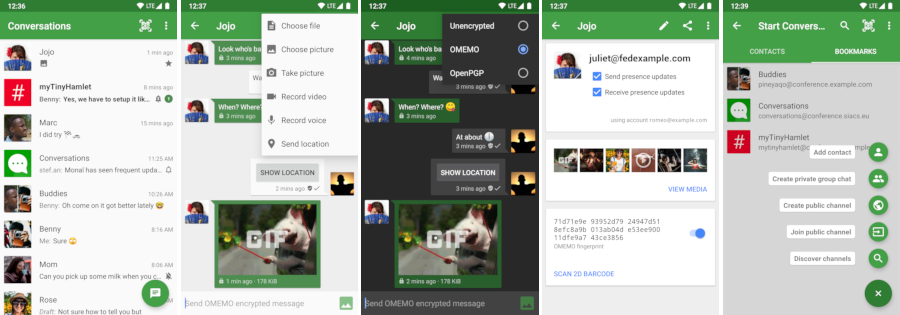
7
8##Design principles
9* Be as beautiful and easy to use as possible without sacrificing security or
10 privacy
11* Rely on existing, well established protocols
12* Do not require a Google Account or specifically Google Cloud Messaging (GCM)
13* Require as little permissons as possible
14
15##Features
16* End-to-end encryption with either OTR or openPGP
17* Holo UI
18* Syncs with your desktop client
19* Group Chats
20* Address book integration
21* Multiple Accounts / unified inbox
22
23###XMPP Features
24Conversations works with every XMPP server out there. However XMPP is an extensible
25protocol. These extensions are standardized as well in so called XEP’s.
26Conversations supports a couple of those to make the overall userexperience better. There is a
27chance that your current XMPP server does not support these extensions.
28Therefore to get the most out of Conversations you should consider either switching to an
29XMPP server that does or - even better - run your own XMPP server for you and
30your friends.
31These XEPs are - as of now:
32* XEP-0065: SOCKS5 Bytestreams - or rather mod_proxy65. Will be used to tranfer files if both parties are behind a firewall (NAT).
33* XEP-0138: Stream Compression saves bandwith
34* XEP-0198: Stream Management allows XMPP to surive small network outages and changes of the underlying TCP connection.
35* XEP-0280: Message Carbons which automatically syncs the messages you send to
36 your desktop client and thus allows you to switch seamlessly from your mobile
37 client to your desktop client and back within one conversation.
38* XEP-0237: Roster Versioning mainly to save bandwith on poor mobile connections
39
40##Contributors
41(In order of appearance))
42* Rene Treffer @rtreffer
43* Andreas Straub @strb
44
45##FAQ
46###General
47####How do I install Conversations?
48Conversations is entirely open source and licensed under GPLv3. So if you are a
49software developer you can check out the sources from github and use ant to
50build your apk file.
51
52The more convenient way - which not only gives you automatic updates but also
53supports the further development of Conversations - is to buy the App in the Google
54[Play Store](https://play.google.com/store/apps/details?id=eu.siacs.conversations).
55
56
57####How do I create an account?
58XMPP like email for example is a federated protocol which means that there is
59not one company you can create your 'official xmpp account' with but there are
60hundreds or even thousands of provider out there. To find one use a web search
61engine of your choice. Or maybe your univeristy has one. Or you can run your own.
62Or ask a friend to run one. Once you found one you can use Conversations to
63create an account. Just select 'register new account on server' within the
64create account dialog.
65####How does the address book integration work?
66The address bock integration was designed to protect your privacy. Conversations
67neither uploads contacts from your address book to your server nor fills your
68address book with unnecessary contacts from your online roster. If you manually
69add a Jabber ID to your phones address book Conversations will use the name and
70the profile picture of this contact. To make the process of adding Jabber IDs to
71your address book easier you can click on the profile picture in the contact
72detais within Conversations. This will start an add to address book intent with the jabber ID
73as payload. This doesn’t require Conversations to have write permissions on your
74address book but also doesn’t require you to copy past Jabber ID from one app to
75another.
76###Security
77####Why are there to end-to-end encryption methods and which one should I choose?
78In most cases OTR should be the encryption method of choice. It works out of the box with most contacts as long as they are online.
79However PGP can be in some cases (carbonated messages to multiple clients) be
80more flexible.
81####How do I use openPGP
82Before you continue reading you should notice that the openPGP support in
83Conversations is marked as experimental. This is not because it will make the app
84unstable but because the fundamental concepts of PGP aren't ready for a
85widespread use. The way PGP works is that you trust Key IDs instead of XMPP- or email addresses. So in theory your contact list should consist of Public-Key-IDs instead of email addresses. But of course no email or xmpp client out there implements these concepts. Plus PGP in the context of instant messaging has a couple of downsides. It is vulnerable to replay attacs, it is rather verbose, decryping and encrypting takes longer than OTR. It is however asynchronous and works well with carbonated messages.
86
87To use openpgp you have to install the opensource app OpenKeychain (www.openkeychain.org) and then long press on the account in manage accounts and choose renew PGP announcement from the contextual menu.
88###Development
89####How do I build Conversations
90Make sure to have ANDROID_HOME point to your Android SDK
91```
92git clone https://github.com/siacs/Conversations.git
93cd Conversations
94git submodule update --init --recursive
95ant clean
96ant debug
97```