1# Getting Started
2
3Welcome to Zed! We are excited to have you. Here is a jumping-off point to getting started.
4
5## Download Zed
6
7### MacOS
8
9You can obtain the stable builds via the [download page](https://zed.dev/download). If you want to download our preview build, you can find it on its [releases page](https://zed.dev/releases/preview) After the first manual installation, Zed will periodically check for and install updates automatically for you.
10
11You can also install Zed stable via Homebrew:
12
13```sh
14brew install --cask zed
15```
16
17As well as Zed preview:
18
19```sh
20brew install --cask zed@preview
21```
22
23### Linux
24
25For most people, the easiest way to install Zed is through our installation script:
26
27```sh
28curl -f https://zed.dev/install.sh | sh
29```
30
31If you'd like to help us test our new features, you can also install our preview build:
32
33```sh
34curl -f https://zed.dev/install.sh | ZED_CHANNEL=preview sh
35```
36
37This script supports `x86_64` and `AArch64`, as well as common Linux distributions: Ubuntu, Arch, Debian, RedHat, CentOS, Fedora, and more.
38
39If this script is insufficient for your use case or you run into problems running Zed, please see our [Linux-specific documentation](./linux.md).
40
41## Command Palette
42
43The Command Palette is the main way to access functionality in Zed, and its keybinding is the first one you should make yourself familiar with.
44
45On macOS, use `⌘-P` (`cmd-shift-p`) to open the Command Palette.
46
47On Linux, use `⌃-P` (`ctrl-shift-p`) to open the Command Palette.
48
49The Command Palette allows you to access pretty much any functionality that's available in Zed.
50
51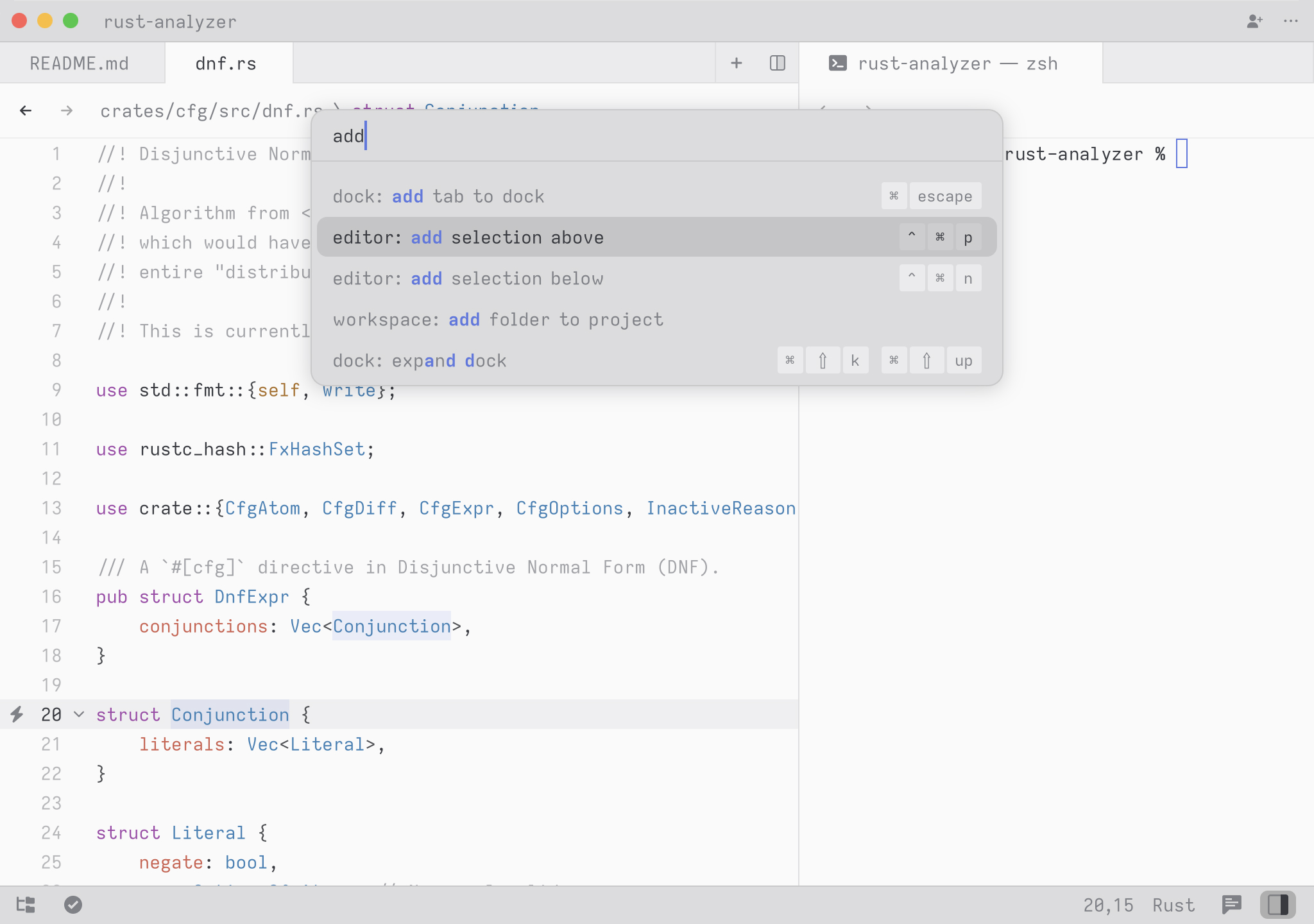
52
53Try it! Open the Command Palette and type in `new file`. You should see the list of commands being filtered down to `workspace: new file`. Hit return and you end up with a new buffer!
54
55Any time you see instructions that include commands of the form `zed: ...` or `editor: ...` and so on that means you need to execute them in the Command Palette.
56
57## Configure Zed
58
59Use `⌘` + `,` to open your custom settings to set things like fonts, formatting settings, per-language settings, and more.
60
61On macOS, you can access the default configuration using the `Zed > Settings > Open Default Settings` menu item. See [Configuring Zed](./configuring-zed.md) for all available settings.
62
63On Linux, you can access the default configuration via the Command Palette. Open it with `ctrl-shift-p` and type in `zed: open default settings` and then hit return.
64
65## Set up your key bindings
66
67On macOS, you can access the default key binding set using the `Zed > Settings > Open Default Key Bindings` menu item. Use `⌘` + `K`, `⌘` + `S` to open your custom keymap to add your key bindings. See Key Bindings for more info.
68
69On Linux, you can access the default key bindings via the Command Palette. Open it with `ctrl-shift-p` and type in `zed: open default keymap` and then hit return.